
By the numbers8 min read
Text to switch: how Ofcom turned PAC codes into a text
Since July 2019, texting PAC to 65075 brings a switching code within a minute. What the rules say, how switching changed, and what porting means for your texts.
In short
- Since 1 July 2019, Ofcom's rules have let a UK mobile customer text PAC to 65075, or STAC to 75075, and get a switching code back within one minute.
- Ofcom's General Conditions make a PAC valid for 30 calendar days and require a mobile switch to be completed no later than one working day after the new provider has the code.
- Ofcom's 2023 evaluation counted 4.1 million completed PAC switches in the 12 months after July 2019, up from 3.5 million in the 12 months before.
- In July 2021, 61% of PAC requests to the largest UK mobile providers were made by text and 10% through an online account, according to Ofcom.
- Ofcom's 2025 Switching Tracker found 16% of mobile decision makers had switched provider in the previous 12 months.
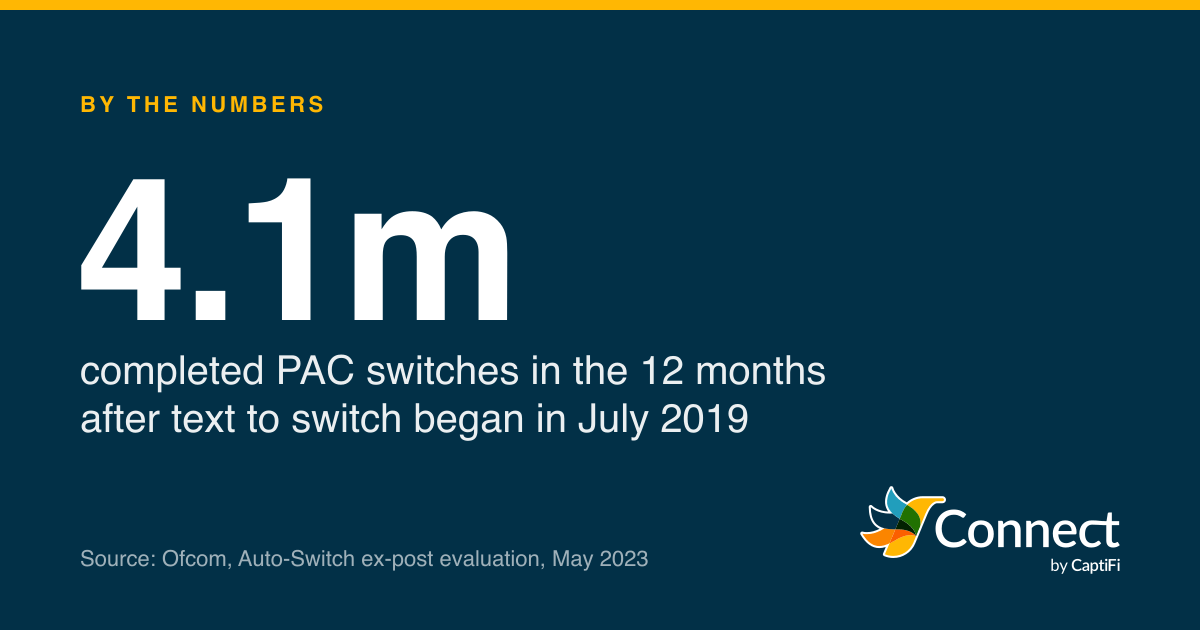
4.1m: completed PAC switches in the 12 months after text to switch began in July 2019. Source: Ofcom, Auto-Switch ex-post evaluation, May 2023.
Since 1 July 2019, anyone in the UK who wants to leave their mobile network and keep their number can text PAC to 65075. The reply, which Ofcom's rules say must arrive within one minute, carries a Porting Authorisation Code and any early termination charges. The new provider then has one working day to complete the switch. Ofcom's own evaluation, published in May 2023, counted 4.1 million completed PAC switches in the first year of the scheme, 0.6 million more than the year before.
For a business, the part that matters is what happens to the number. It moves with the customer, and the texts you send to it keep arriving on the new network.
What did switching look like before 2019?
Ofcom set out the problem in a statement of December 2017. To keep their number, a customer had to contact their existing provider and ask for a PAC, which most providers handled by phone, and which "often resulted in being exposed to unwanted persuasion to remain". Many contracts also made people pay for a notice period after their old service had already stopped, and some customers lost service during the switch. Ofcom's research found that 15% of people who hadn't switched or considered it, around 5.9 million, said worries about the process were the main reason.
The reforms Ofcom announced that December, which it called the Auto-Switch reforms, came into force in July 2019. They had three parts: a code you could get by text or online without speaking to anyone, a ban on notice-period charges after the switch date, and clear information on what switching would cost before you did it.
What do the rules say now?
The rules live in Ofcom's General Conditions, condition C7, and the version in force from 8 April 2026 spells them out. Every mobile provider must let customers request a PAC or STAC, free, by text (for a single number), through an online account and by phone. The text numbers are set by industry and approved by Ofcom, and Ofcom's switching page, last updated on 25 August 2026, lists them.
| Text | Send to | What comes back |
|---|---|---|
| PAC | 65075 | A code to switch and keep your number |
| STAC | 75075 | A code to switch without keeping your number |
| INFO | 85075 | Whether you're in contract, and what leaving would cost |
For residential customers the code must arrive "no later than one minute from receipt of the request", and it comes with switching information: any early termination charge, and what happens to bundled services. A PAC or STAC "shall be valid from the day it is provided for a period of thirty calendar days". If a provider turns a request down, it has to confirm the rejection by text straight away.
Once the customer hands the code to the new provider, the switch must be done "as soon as possible" and no later than one working day after the code is submitted (or after the new SIM is activated, if the code went in at the point of sale), unless the customer asks for a particular date. Any loss of service during the switch mustn't exceed one working day, the old contract ends automatically when the switch completes, and the customer pays no notice-period charges beyond the switch date. Providers must compensate customers if things go wrong.
A few smaller duties fill in the gaps. Providers have to publicise all three routes, with a link no more than two clicks from their main web page. The new provider has to give the customer the option of handing over the code at the point of sale, so the code can go in with the order. A pay-as-you-go customer can ask the old provider to refund any remaining credit, less proportionate fees set out in their contract. Business tariffs get their own timings: a code requested by phone should be given straight away (or by text within two hours of the call), and one requested by text can take up to two working days.
Two limits are worth knowing. The text route only works for one number at a time, so a family account with several numbers has to request codes online or by phone. And the Auto-Switch conditions only cover switches of fewer than 25 numbers at a time.
What does that look like for a customer?
Say a customer texts PAC to 65075 at 7pm on Thursday 5 November 2026. The code and the switching information have to arrive by 7:01pm, and the code stays valid for 30 days, so it will still work in early December. If they give it to their new provider on Friday 6 November, the switch has to be finished by Monday 9 November at the latest (the next working day) unless they ask for a later date. They don't phone anyone, they don't pay the old network for a notice period after Monday, and their number goes with them, along with every text a business sends to it.
The same idea has since spread beyond mobiles. Ofcom's One Touch Switch process for broadband and landlines, launched in September 2024, lets a customer switch by contacting only the new provider, and Ofcom says over two million customers had used it by the end of 2025.
How many people use it?
More than Ofcom expected. Its 2023 evaluation used data from the Central Porting System, run by Syniverse, which supports mobile number portability in the UK. In the 12 months before 1 July 2019 there were 4.4 million PACs requested and 3.5 million completed switches. In the 12 months after, requests rose to almost 5.8 million and completed switches to 4.1 million, and completed PAC switches reached 4.2 million in 2021.
- PACs requested
- PAC switches completed
Central Porting System data from Syniverse, excluding bulk requests of 25 numbers or more. Ofcom describes the requested figure after July 2019 as "almost 5.8 million".
Source: Ofcom, Auto-Switch: an ex-post evaluation, 10 May 2023 (paragraph 4.5)
See the figures as a table
| PACs requested (m) | PAC switches completed (m) | |
|---|---|---|
| 12 months before | 4.4 | 3.5 |
| 12 months after | 5.8 | 4.1 |
The gap between requested and completed codes widened after 2019, and Ofcom suggests why: people were using the free code to check whether they were out of contract, or as a bargaining chip with their current provider. The INFO route shows the same appetite for checking. In the last seven months of 2021, customers of the largest providers texted INFO to 85075 about 900,000 times, over a period when they requested 3.7 million PACs and used 2.6 million.
Text quickly became the main route. Ofcom's Switching Experience Tracker had 51% of PAC requests made by text in 2020 and 26% online. Data from the largest providers for July 2021 put text at 61% and online at 10%. Business customers stuck to the phone: 76% of their PAC requests that month were by phone, 18% by text and 5% online. Ofcom's evaluation puts the share of customers requesting a PAC by text or online at 71%, against the 51% it had expected.
The code for leaving without your number barely caught on. Just over 241,000 STACs were requested in the first year and only 11% (26,000) led to a completed switch. In 2021 it was fewer than 215,000 requests and 21,000 switches, about a fifth of the 100,000 a year Ofcom had expected.
Did more people switch?
On Ofcom's survey, yes, though Ofcom is cautious about why. Its Switching Tracker found 12% of mobile customers had switched provider in the previous 12 months in 2019, 16% in 2020, 16% in 2021 and 15% in 2022. The survey method changed after 2019 (the pandemic moved it from face to face to online, phone and post), and the evaluation says the rise can't be pinned entirely on the reforms, since end-of-contract notifications arrived in February 2020 and the Covid-19 lockdowns may have played a part.
Ofcom Switching Tracker. The 2019 survey was face to face and later waves online, by phone and by post, so 2019 is not directly comparable.
Source: Ofcom, Auto-Switch: an ex-post evaluation, 10 May 2023 (footnote 78, Switching Tracker)
See the figures as a table
| Switched provider (%) | |
|---|---|
| 2019 | 12 |
| 2020 | 16 |
| 2021 | 16 |
| 2022 | 15 |
The latest wave, run in August and September 2025, put mobile switching at 16%, and Ofcom's Pricing and consumer engagement report of 26 February 2026 describes mobile switching as stable. The same report estimates the reforms will save customers £130 million over ten years, about £15 million more than Ofcom originally forecast.
What does a ported number mean for your texts?
Providers must offer number portability to any customer who asks, and the definition in the General Conditions says what it does: it lets a customer "retain their Telephone Number(s) on a Public Electronic Communications Network, independently of the person providing the service". So a customer who moves from one network to another with a PAC keeps the same mobile number, and the texts you send to it reach them on the new network. There's nothing for you to update.
What you can't do is tell a customer's network from their number. Ofcom's numbering data shows which provider each block of numbers was allocated to, and a ported number stays in its original block, so a number that started life on one network may be served by another today. Our post on UK mobile numbers and the numbering plan explains the blocks and why they're a map of where numbers came from.
The switch itself can cause a short gap. The rules allow up to one working day without service, and a text sent while the number is between networks may be held and delivered once the phone is live again, which our post on why a text can arrive late describes.
The bigger risk is the customer who leaves with a STAC, or cancels without moving their number. Providers only have to keep the number available to port for a minimum of one month after the contract ends. After that the provider no longer has to let them take it, and texts to it won't reach them. One sign is a run of failed deliveries, so when a regular customer's number starts failing, ask for their new one at the next contact before assuming they've left.
CaptiFi Connect records a delivery report for every text, with the time the network accepted it and the final status, which is the quickest way to spot a number that has stopped working.
Ofcom moved its Switching Tracker to every two years after 2023, so the next mobile switching figure should come from a 2027 survey.
Sources
Read for this post on 22 October 2026.
- Ofcom: Auto-Switch, an ex-post evaluation of the impact of the Auto-Switch reforms, 10 May 2023
- Ofcom: General Conditions of Entitlement, unofficial consolidated version in effect from 8 April 2026
- Ofcom: Switching mobile phone provider (updated 25 August 2026)
- Ofcom: Pricing and consumer engagement, 26 February 2026
- Ofcom: Text to switch, 1 July 2020
Written by the CaptiFi Connect team. Published 22 October 2026. More in By the numbers
Send your first text this week
Set up your account and contacts now. Until we've approved it, a person reads each text before it goes out.