
By the numbers8 min read
A reminder letter or a text: what each costs
A Second Class stamp has cost 91p since April 2026, and 75.7% of First Class mail arrived next day in 2025/26. What a reminder letter costs against a text.
In short
- Royal Mail raised the Second Class stamp to 91p and the First Class stamp to £1.80 from 7 April 2026, up from 66p and 85p in April 2021 on Ofcom's figures.
- Royal Mail delivered 75.7% of First Class mail the next working day in 2025/26 against a 93% target, and Ofcom opened an investigation into that performance on 1 June 2026.
- Ofcom fined Royal Mail £21 million in October 2025 for missing its 2024/25 delivery targets, after fines of £5.6 million in November 2023 and £10.5 million in December 2024.
- GOV.UK Notify charges public bodies 73p plus VAT for a one-sheet second class letter and 2.4p plus VAT for a single text message of up to 160 characters.
- Ofcom proposed on 16 October 2026 to extend the Second Class stamp safeguard cap, which holds price rises to CPI inflation, for one more year to 31 March 2028.
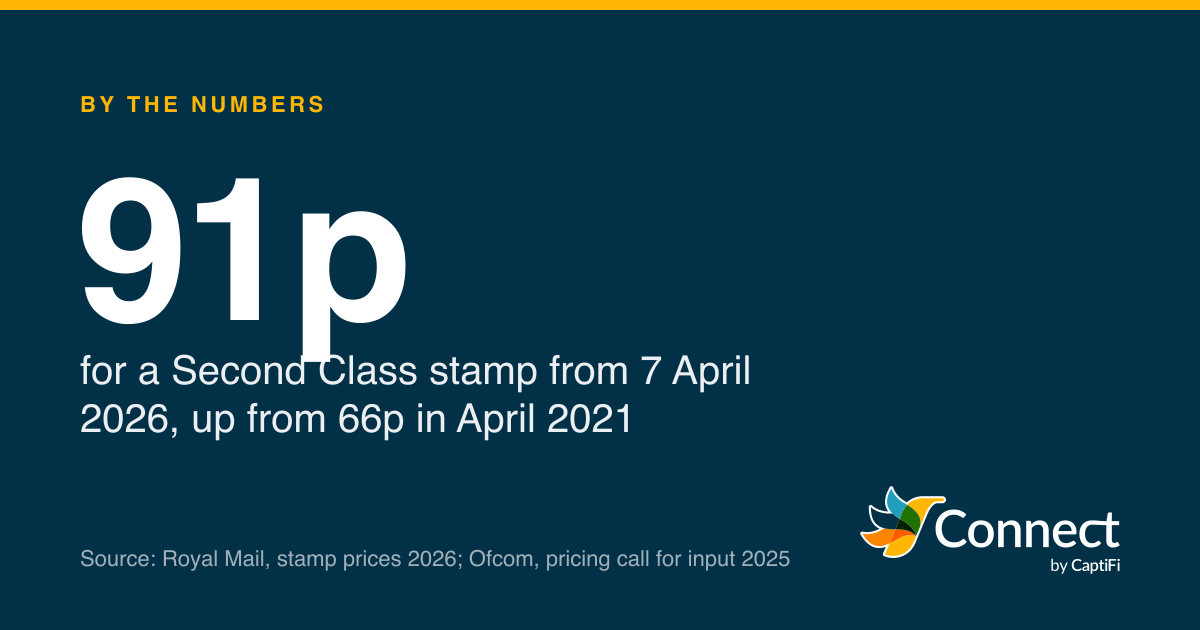
91p: for a Second Class stamp from 7 April 2026, up from 66p in April 2021. Source: Royal Mail, stamp prices 2026; Ofcom, pricing call for input 2025.
A Second Class stamp has cost 91p since 7 April 2026, and a First Class stamp £1.80. Royal Mail announced both prices on 6 March 2026. Speed hasn't kept pace with price: Royal Mail's own results for the year to March 2026 showed 75.7% of First Class mail delivered the next working day, against a target of 93%, and Ofcom opened another investigation into the company's delivery performance on 1 June 2026. A text, by comparison, costs from 2.4p plus VAT (GOV.UK Notify's price to public bodies) to about 5p, and is handed to the mobile network in seconds.
What a stamp costs now
Ofcom's call for input on postal pricing, published on 4 November 2025, has a table of stamp prices each April. A First Class stamp was 85p in April 2021, then 95p, £1.10, £1.35 and £1.70 in April 2025. A Second Class stamp went 66p, 68p, 75p, 85p and 87p over the same years. Ofcom worked out that First Class had risen 100% in nominal terms between April 2021 and April 2025, but 59% after inflation. Royal Mail's March 2026 announcement then added 10p to First Class and 4p to Second.
- First Class
- Second Class
Standard letter stamps, nominal prices. April 2021 to April 2025 from Ofcom; April 2026 from Royal Mail's announcement of 6 March 2026.
Source: Ofcom, Call for input: pricing and affordability, November 2025 (table 1)
See the figures as a table
| First Class (£) | Second Class (£) | |
|---|---|---|
| 2021 | 0.85 | 0.66 |
| 2022 | 0.95 | 0.68 |
| 2023 | 1.1 | 0.75 |
| 2024 | 1.35 | 0.85 |
| 2025 | 1.7 | 0.87 |
| 2026 | 1.8 | 0.91 |
Royal Mail's explanation is volume. Its 2026 announcement says the average household now receives four letters a week, down from 14 at the peak over 20 years ago, while the number of addresses has risen by four million to 32 million. Ofcom puts the national figure at around 14 billion letters in 2011/12 and about 6.5 billion in 2024/25. Delivering one letter or five to the same house on the same round costs nearly the same, so fewer letters means a higher cost for each one. By Ofcom's comparison of broadly similar non-priority services, a 91p Second Class stamp is still less than half the European mean of £2.07 and about half the median of £1.81.
Royal Mail also says UK adults spend £6.50 each on stamps a year on average, and that 70% fewer letters are sent than 20 years ago. Ofcom's measure of what households spend is small too: around £2.60 a month on postal services in 2023/24. For a business sending reminders by the hundred the sums are bigger, and the stamp is only the start: paper, printing, envelopes and someone's time folding them come on top.
The cap on Second Class
Only one of those prices is regulated. Ofcom has kept a safeguard cap on Second Class letters since 2012, when it set the cap at 55p against a stamp price of 36p. The current version, set in January 2024, is a basket cap on Second Class standard and large letters that lets the maximum price rise no faster than CPI inflation, and it runs to March 2027. The cap covers Second Class only; Ofcom describes First Class as a premium service for the less frequent occasions when people choose to pay more for speed.
The cap has stopped being theoretical. Ofcom's October 2026 consultation says that since 2021 it "has consistently been binding" on Second Class standard letters, with Royal Mail pricing at or very close to the maximum. On 16 October 2026 Ofcom proposed extending the cap at its current level for one more year, to 31 March 2028, while it works out a longer-term approach. The consultation closes on 27 November 2026, and Ofcom says it plans to consult on long-term pricing in the first quarter of 2027/28. The same document says real letter prices are likely to need to rise over time.
How quickly a letter arrives
Until March 2026 Royal Mail's targets were 93% of First Class mail delivered the next working day and 98.5% of Second Class within three working days, measured from April to March with the Christmas period left out. It hasn't met either for years. On the figures in Ofcom's monitoring report, First Class managed 73.7% in 2022/23, 74.5% in 2023/24 and 76.5% in 2024/25, and Ofcom's June 2026 announcement gives 75.7% for 2025/26, with Second Class at 90.2%.
- Delivered next working day
- Target
Royal Mail's reported results, April to March, excluding the Christmas period. 2025/26 is from Ofcom's announcement of 1 June 2026. The target fell to 90% from 1 April 2026.
Source: Ofcom, Post monitoring report 2024-25
See the figures as a table
| Delivered next working day (%) | Target (%) | |
|---|---|---|
| 2022/23 | 73.7 | 93 |
| 2023/24 | 74.5 | 93 |
| 2024/25 | 76.5 | 93 |
| 2025/26 | 75.7 | 93 |
Ofcom has fined the company three times for it: £5.6 million in November 2023, £10.5 million in December 2024 and £21 million in October 2025. The last was for 2024/25, when, after allowing for two storms, Royal Mail delivered 77% of First Class and 92.5% of Second Class mail on time. Ofcom called it the third largest fine it has ever imposed, cut by 30% from £30 million because Royal Mail admitted liability and settled.
The rules changed in 2025. In July Ofcom lowered the targets, from 1 April 2026, to 90% for First Class next day and 95% for Second Class within three days, and added a backstop: 99% of mail delivered no more than two days late. From 28 July 2025 it also allowed Royal Mail to deliver Second Class letters on alternate weekdays, Monday to Friday, while First Class stays six days a week. Royal Mail reached agreement with the Communication Workers Union in April 2026, started rolling out the new pattern in June, and expects to finish by Christmas 2026. Its improvement plan, Ofcom says, commits £500 million over five years and sets a quarter-by-quarter path to meeting the targets by April 2027.
For a reminder, the date matters more than the speed. Second Class on alternate weekdays, within three working days, means a letter posted on a Thursday about an appointment the following Tuesday can arrive on the Tuesday itself and still count as on time.
What people and small businesses say about the post
Ofcom's monitoring report for 2024-25, published on 3 December 2025, puts the experience in numbers. Over four in ten consumers (44%) had a problem sending or receiving letters during the year, most often delayed post (24%) or mail delivered to the wrong address (18%). Two thirds (66%) said they now send fewer letters because of the cost of postage, up from 62%, and only 39% rated First Class letters good value for money, down from 47% two years earlier. Royal Mail logged 2.47 million complaints in 2024-25, and loss was the biggest category at 1.12 million.
Small firms are no happier on price. Only 46% of SMEs were satisfied with Royal Mail's prices, against 71% for other postal operators, and 75% were satisfied with its delivery consistency and reliability, against 83% for other providers. Two in five SMEs that used Royal Mail (40%) had a problem with the service in the previous six months.
Most letters now come from large organisations. Ofcom's July 2025 announcement noted that 63% of letters are bulk mail from large organisations such as banks, government departments, the NHS and councils, sent outside the universal service through Royal Mail's network.
The public sector's own price list
GOV.UK Notify, the government's messaging platform, publishes prices for letters and texts side by side, which makes for a direct comparison. A one-sheet letter, printed in colour, put in a window envelope and posted, costs 73p plus VAT by Second Class, £1.56 by First Class and 63.8p by Royal Mail's economy service, on prices updated on 1 July 2026. A single text of up to 160 characters costs 2.4p plus VAT, after a free yearly allowance. On Notify's own price list, a Second Class letter costs about 30 times as much as a text.
The delivery times are further apart still. Notify prints letters at 5:30pm and dispatches them the next working day, and estimates 1 to 2 days for First Class, 3 to 4 working days for Second Class and 3 to 6 for economy, all counted from dispatch. For texts it commits to sending 95% within 10 seconds, and its text provider then keeps trying to deliver for up to 72 hours if the phone is off. Our post on GOV.UK Notify's numbers has the volumes behind those prices.
What 1,000 reminders cost
Take 1,000 appointment reminders, each short enough to fit one text (160 standard characters) or one sheet of paper. Postage and per-message prices only:
| Route | Price each | 1,000 reminders | Arrival |
|---|---|---|---|
| First Class stamp | £1.80 | £1,800 | Next working day, 90% target |
| Second Class stamp | 91p | £910 | Within 3 working days, 95% target |
| Notify letter, Second Class (public bodies) | 73p plus VAT | £730 plus VAT | 3 to 4 working days after dispatch |
| Notify text (public bodies) | 2.4p plus VAT | £24 plus VAT | 95% sent within 10 seconds |
| Business text at 5p (two 500-credit packs) | 5p | £50 | Seconds to the network |
The stamp rows leave out paper, envelopes, printing and staff time, which Notify's letter price includes and a stamp doesn't. The text rows assume one part: a text over 160 characters, or one with an emoji, is split into parts and charged per part, as our character limit guide explains. Even at two parts, a text costs a fraction of a stamp, and bigger packs bring the price per text down to 3.5p on the 20,000-credit pack.
Scale it to a hypothetical dental practice in Leeds sending 400 recall reminders a month. By Second Class post that's £364 a month in stamps alone, or £4,368 over a year. At 5p a text it's £20 a month and £240 a year, and at 4.5p (the 2,000-credit pack) it's £18 a month.
A letter is still the right tool for some jobs. Formal notices, such as a council tax reminder notice or a section 13 rent increase notice, follow their own rules on how they're served, and a text can tell the recipient one is on its way. Our posts on council tax and bin day texts and on texting tenants cover those cases. For reminders that only exist to get someone to turn up on the right day, Ofcom's own targets now allow a Second Class letter up to three working days.
CaptiFi Connect's prepaid packs run from 500 credits for £25 (5p a text) to 20,000 credits for £700 (3.5p a text), with no VAT added, credits that never expire, and nothing charged for texts refused before sending. Every text gets a delivery report with a timeline, which tells you whether a reminder reached the phone; a letter can't tell you that. The pricing page has the full list, and our post on what a text costs in the UK covers how the price of a text fell to this level.
Sources
Read for this post on 22 October 2026.
- Royal Mail: Royal Mail stamp prices 2026, 6 March 2026
- Royal Mail: Royal Mail stamp prices 2025, 7 March 2025
- Ofcom: Call for input, review of postal regulation, pricing and affordability, 4 November 2025
- Ofcom: Consultation, interim review of Second Class cap, 16 October 2026
- Ofcom: Interim review of Second Class cap, consultation document
- Ofcom: Reforming the postal service so it delivers what people need, 10 July 2025
- Ofcom: Ofcom fines Royal Mail £21m for missing its 2024/25 delivery targets, 15 October 2025
- Ofcom: Ofcom investigates Royal Mail's 2025/26 delivery performance, 1 June 2026
- Ofcom: Post monitoring report, postal services in the financial year 2024-25
- GOV.UK Notify: Letter pricing
- GOV.UK Notify: Text message pricing
- GOV.UK Notify: Delivery times
Written by the CaptiFi Connect team. Published 22 October 2026. More in By the numbers
Send your first text this week
Set up your account and contacts now. Until we've approved it, a person reads each text before it goes out.