
By the numbers8 min read
Landline switch-off 2027: why mobile numbers matter
BT retires its old landline network by 31 January 2027, and landline calls fell to 14.5bn minutes in 2025. Why the mobile number is now the contact to hold.
In short
- BT plans to retire its old copper landline network, the PSTN, by 31 January 2027, according to Ofcom's consumer guidance last updated on 26 August 2026.
- Ofcom's market data shows calls made from UK landlines fell to 14.5 billion minutes in 2025, from 18.0 billion in 2024, while mobiles made 149.2 billion minutes of calls.
- Ofcom counted 3.2 million residential landline customers still on the old PSTN in July 2025, down from 5.2 million a year earlier.
- Ofcom's Technology Tracker for March 2026 found 64% of UK adults had no landline service at home, while 98% personally used a mobile phone.
- In the second quarter of 2025, 70% of UK households that bought broadband and a landline together made no outgoing landline call, according to Ofcom.
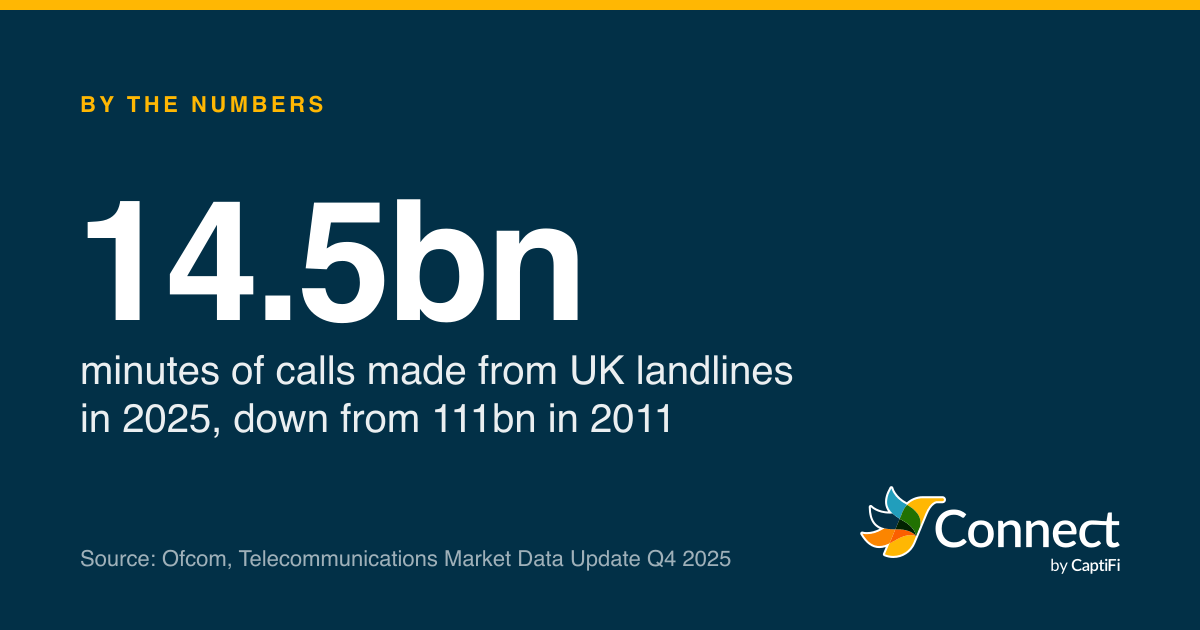
14.5bn: minutes of calls made from UK landlines in 2025, down from 111bn in 2011. Source: Ofcom, Telecommunications Market Data Update Q4 2025.
BT plans to retire its old copper landline network, the public switched telephone network or PSTN, by 31 January 2027. That's the date on Ofcom's consumer guidance, last updated on 26 August 2026, and it means every landline still running on the old network moves to a digital line that works over broadband. People keep their numbers. What's changed far more than the plumbing is how little those numbers get used: Ofcom's market data shows calls made from UK landlines fell to 14.5 billion minutes in 2025, against 111 billion in 2011, and its March 2026 Technology Tracker found 64% of UK adults had no landline service at home at all.
For a business that keeps a phone number for each customer, that changes which number is worth having.
What is being switched off, and when?
The PSTN is the copper telephone network that has carried landline calls for decades. Ofcom's Connected Nations report, published on 19 November 2025, says the UK's copper-based PSTNs "are beyond their intended lifespans and are becoming increasingly unreliable", and that BT and Openreach "are now looking to retire BT's PSTN and the Openreach wholesale services that deliver PSTN by January 2027". Calls move to Voice over Internet Protocol (VoIP), "commonly known as a digital landline". Ofcom's consumer page adds that Virgin Media O2 and KCOM also plan to retire their old networks, but that "dates for switching those have not yet been set".
The January 2027 date comes from BT. Its announcement of 20 May 2024 said all customers were "now expected to have moved off the old analogue PSTN by the end of January 2027". For customers without broadband, BT said new equipment would go into local telephone exchanges so they could keep using their landline "until a digital solution becomes available or 2030, if that comes sooner". Ofcom calls this BT's "pre-digital phone line", an interim option for difficult cases such as landline-only and critical national infrastructure customers.
It hasn't been a straight line. In December 2023 the main providers signed a charter with the government that committed them not to carry out "any non-voluntary migrations" until they were confident vulnerable people were protected, and not to move telecare users without confirming "a compatible and functioning telecare solution in place". Ofcom says migrations "slowed significantly in 2024" as a result, and that the government agreed over summer 2025 to several providers restarting them.
Ofcom's latest count, from provider data for July 2025, looks like this.
| Residential landlines by technology, July 2025 | Customers | Share |
|---|---|---|
| Still on the PSTN | 3.2 million | 19% |
| Digital (VoIP) | 9.8 million | 57% |
| Emulated PSTN | 4.2 million | 24% |
| All residential landlines | 17.2 million | 100% |
That 3.2 million was down from 5.2 million a year earlier. In the year to July 2025, 1.9 million residential customers moved from the PSTN to VoIP with their existing provider (a third of them moved by the provider, two thirds at their own request), and "just over a million households" gave up their landline altogether for a broadband-only service. Ofcom expects the customers left to be the harder cases, because providers moved the easy ones first. On the business side, BT said in March 2026 that around 80% of its business voice customers had moved to all-IP services by January 2026.
What changes for the person you're calling?
Less than you might expect, with one big exception. Ofcom's page says "You can keep your phone number", and the phone plugs into the broadband router where it used to go into the wall socket. The exception is power: "Digital landlines need mains electricity and will not work in a power cut unless there is a battery back-up." Providers must offer people who need one a back-up that lasts "at least one hour in a power cut", and anyone with no working mobile or reliable mobile signal is entitled to a free back-up solution.
That last rule treats the mobile as the phone that keeps working when the landline doesn't. Telecare alarms, health pendants and personal alarms are the other worry, and Ofcom asks anyone with one to tell their provider before the switch. For older, disabled or otherwise vulnerable customers, Ofcom says the provider must assess their needs and support the move.
How far has landline calling fallen?
A long way, and it was falling well before anyone set a date. Ofcom's Communications Market Report put calls made from UK landlines at 111 billion minutes in 2011. By 2017 it was 54 billion. The quarterly data updates Ofcom has published since give 47.0 billion for 2018, 39.0 billion for 2019 and then a jump to 46.7 billion in 2020, when lockdown sent everyone home. After that the fall resumed and sped up: 40.3 billion in 2021, 29.2 billion in 2022, 23.3 billion in 2023, 18.0 billion in 2024 and 14.5 billion in 2025, a fall of almost a fifth in a single year.
2011 to 2016 from the Communications Market Report 2017 and 2017 from the 2018 report, rounded to the nearest billion, which Ofcom says understate VoIP calls. 2018 onwards from the Q4 data updates, each year from the latest edition that gives it, converted from millions.
Source: Ofcom, Telecommunications Market Data Update Q4 2025 (table 3) and earlier editions
See the figures as a table
| Fixed call minutes (bn) | |
|---|---|
| 2011 | 111 |
| 2012 | 103 |
| 2013 | 93 |
| 2014 | 82 |
| 2015 | 74 |
| 2016 | 65 |
| 2017 | 54 |
| 2018 | 47.02 |
| 2019 | 39.03 |
| 2020 | 46.73 |
| 2021 | 40.34 |
| 2022 | 29.19 |
| 2023 | 23.31 |
| 2024 | 18.01 |
| 2025 | 14.5 |
Two cautions on the chart. Ofcom says its older figures understate VoIP calls, and it restates recent years when better data arrives (2022 was 32.1 billion minutes in the first update to report it and 29.2 billion a year later), so we've taken each year from the latest edition. The direction isn't in doubt. Homes made 8.5 billion of the 2025 minutes, down from 11.4 billion in 2024, a quarter fewer in a year. Calls into landlines are shrinking too: mobiles spent 25.1 billion minutes calling UK landlines in 2025, against 27.4 billion the year before. For comparison, mobiles made 149.2 billion minutes of outgoing calls in all in 2025, about ten times the landline total, and the number of fixed lines (PSTN lines, ISDN channels and managed VoIP connections) fell to 21.4 million by the end of 2025, from 31.5 million at the end of 2018.
Ofcom's Pricing and consumer engagement report, published on 26 February 2026, puts the household side of it plainly. Take-up of fixed voice services "has decreased significantly since 2020 (from 78% to 40%)", and in the second quarter of 2025, "70% of households which bought their broadband and fixed voice together did not make an outgoing call". Most landlines now come with the broadband: operator data in the same report shows standalone customers were just 4% of all fixed voice customers.
Who still has a landline?
Older customers, mostly. Ofcom's Technology Tracker, an Ipsos survey of 4,033 adults in March 2026, asked whether people have a landline service at home. Across all adults, 35% said yes and 64% said no, and the yes includes 6% whose line has no handset connected and 3% whose phone can only receive calls. Northern Ireland has the most landlines at 46% of adults, then Scotland at 39%, England at 35% and Wales at 33%. By age, it's 21% of 16 to 24 year olds, 17% of 25 to 44s, 40% of 45 to 64s, 57% of 65 to 74s and 77% of those aged 75 and over. The same survey has 98% of adults personally using a mobile phone, ranging from 100% of 25 to 44s down to 89% of over-75s.
- Landline service at home
- Personally use a mobile
Share of all adults in each age group. Ipsos fieldwork in March 2026, 4,033 UK adults aged 16 and over. A landline service includes lines with no handset connected.
Source: Ofcom, Technology Tracker 2026 core data tables (tables 79 and 105)
See the figures as a table
| Landline service at home (%) | Personally use a mobile (%) | |
|---|---|---|
| All adults | 35 | 98 |
| 16 to 24 | 21 | 99 |
| 25 to 44 | 17 | 100 |
| 45 to 64 | 40 | 99 |
| 65 to 74 | 57 | 97 |
| 75 and over | 77 | 89 |
Having a landline isn't the same as using it. Of the people whose landline can make calls, 36% said they never used it to make a call in the previous three months. That falls to 12% among over-75s, 43% of whom said they always use the landline to make calls. There's a geographic tilt as well: 42% of rural adults have a landline service against 34% in towns and cities, and in London it's 24%.
So the people most likely to have and use a landline are the over-75s, who are also the one group where mobile use drops below nine in ten. For them the landline is still a real channel, and our post on who you reach by text and not by email covers the same age group from the internet side.
What should you do with the numbers you hold?
Make the mobile number the one you ask for first. Nearly every adult uses one, it reaches the customer wherever they are, and it can take a text. Say a garage keeps one phone field per customer and sends its MOT reminders by text: every record holding a landline is a reminder that can't go out, for a customer who almost certainly has a mobile nobody asked for (our post on MOT reminder texts covers the reminders themselves). If your booking form or customer record has a single "phone" field, split it into mobile and landline so you know which is which, and check old records for 01, 02 and 03 numbers sitting in a mobile column. Our post on UK mobile numbers explains how to tell a mobile from everything else by its first digits.
Keep the landline where the customer has one, and use it for the customers who prefer it. A dental practice with a lot of patients over 75 will still reach some of them best by phoning the house, and the switch-off doesn't change that number. Expect records to go stale faster, though. A million households dropped their landline in a single year, and a home number on file may no longer connect to anyone.
Check your own lines too. If your business number is a landline it moves to digital with you and keeps its number, but anything else that runs over the old network needs checking with your provider. BT's advice to business customers in March 2026 was to work out which services rely on the PSTN and move them before the deadline.
For the messages that matter most (an appointment tomorrow, a change of plan) send a text to the mobile and, for customers who rely on the landline, follow up with a call. CaptiFi Connect sends texts to UK mobile numbers only and refuses landline numbers before any credit is spent, so a list with landlines mixed in costs nothing for the numbers that can't take a text; the appointment reminders page shows how a reminder and reply work.
The deadline on Ofcom's page is 31 January 2027, a little over three months away. If the only number you hold for a customer is a landline, that's the record to update first.
Sources
Read for this post on 22 October 2026.
- Ofcom: Your landline is going digital, what you need to know (updated 26 August 2026)
- Ofcom: Connected Nations 2025, UK report, 19 November 2025
- BT Group: BT Group refines its digital switchover programme, 20 May 2024
- BT Group: The PSTN switchover, how BT is supporting businesses in the final phase, 20 March 2026
- GOV.UK: Public Switched Telephone Network charter
- Ofcom: Telecommunications Market Data Update Q4 2025
- Ofcom: Telecommunications Market Data Update Q4 2024
- Ofcom: Telecommunications Market Data Update Q4 2023
- Ofcom: Telecommunications Market Data Update Q4 2022
- Ofcom: Telecommunications Market Data Update Q4 2021
- Ofcom: Telecommunications Market Data Update Q4 2020
- Ofcom: Telecommunications Market Data Update Q4 2019
- Ofcom: Communications Market Report 2017, telecoms and networks
- Ofcom: Communications Market Report 2018, narrative report
- Ofcom: Technology Tracker 2026, core data tables
- Ofcom: Pricing and consumer engagement, 26 February 2026
Written by the CaptiFi Connect team. Published 22 October 2026. More in By the numbers
Send your first text this week
Set up your account and contacts now. Until we've approved it, a person reads each text before it goes out.